


Professional Interpreter Service Thailand
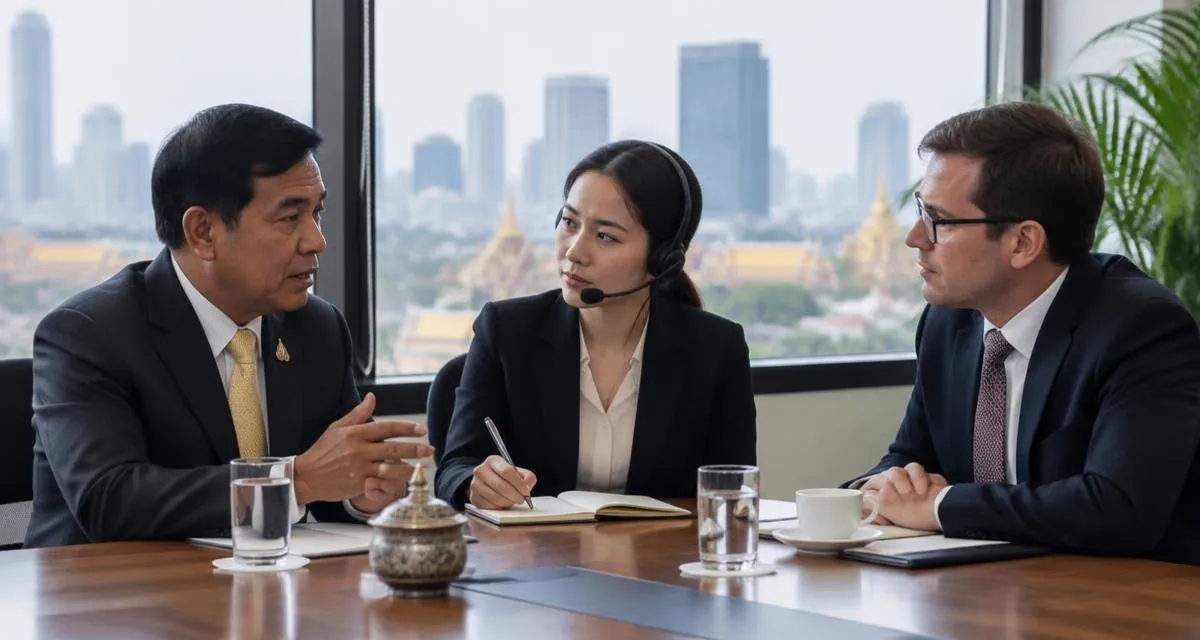
How do I book a certified interpreter in Thailand?
Tell us the language pair, date, place and type of appointment, such as District Office, court or a business meeting. We match an interpreter with the right experience and confirm whether the office needs a signed interpreter statement. Book early and check the office's requirements in advance.
Court · Business · Medical · Conference — 30+ language pairs with MOJ-approved court interpreters.
Quick Answer
Consecutive interpreter from a fee quoted after review half-day. Simultaneous (booth + 2 interpreters) from a fee quoted after review. MOJ court roster available same-week.
Scenarios we cover
- ✓ Criminal / Civil / Labour Court hearings
- ✓ Immigration & deportation interviews
- ✓ Notary public depositions
- ✓ Business M&A negotiations
- ✓ Board & shareholder meetings
- ✓ Medical consultations & IVF clinics
- ✓ Real-estate closings
- ✓ Marriage registration at Amphur
- ✓ Police station witness statements
- ✓ Conference simultaneous (booth)
FAQ
- Which languages do you cover on-site in Thailand?
- Thai↔English, Chinese (Mandarin & Cantonese), Japanese, Korean, Russian, Arabic, German, French, Spanish, Portuguese, Vietnamese, Bahasa (Indonesian & Malay), Hindi, Bengali, Nepali, Burmese, Khmer, Lao — 30+ language pairs with certified interpreters.
- Court interpreter — are your interpreters approved?
- Yes. Our court interpreters are listed on the Ministry of Justice roster and have appeared at Criminal Court, Civil Court, Immigration Court, and Labour Court. We handle sworn oaths under Section 13 of the Court Interpretation Regulations.
- Simultaneous vs. consecutive — which do I need?
- Consecutive (speaker pauses, interpreter renders) works for meetings ≤10 people, depositions, medical consultations. Simultaneous (real-time via headset) is for conferences ≥20 people, board meetings, live broadcasts — requires 2 interpreters + booth.
- Rates?
- Fees depend on the documents, destination and urgency. Send your documents for a written quote after review — no prices are published. Any government or embassy fees are set by the authority; verify them directly before filing.
Contact: 083-2494999 · LINE @NYC168 · contact@nyclegal.co.th
Modes of interpreting and when each is appropriate
Consecutive interpreting, where the speaker pauses and the interpreter renders each segment, is the correct mode for depositions, police interviews, notarial appointments, medical consultations and small negotiations. It roughly doubles the elapsed time but produces the most controllable record, which is exactly what a court or a registrar wants.
Simultaneous interpreting, delivered from a booth or with a portable system while the speaker continues, suits conferences, board meetings and training sessions. It preserves the pace of the event but requires two interpreters per language pair for anything longer than about an hour, because sustained simultaneous work degrades measurably after that point. A single interpreter booked for a full-day conference is a false economy.
Whispered interpreting, delivered quietly to one or two listeners, is a variant of simultaneous suited to a foreign director attending a Thai-language board meeting. Sight translation, reading a written document aloud in the target language, is common at district offices and land offices where a Thai instrument must be understood before signature.
Matching the assignment to the right interpreter
| Setting | Mode | What the interpreter must bring |
|---|---|---|
| Court hearing or deposition | Consecutive | Procedural terminology, comfort with objections, willingness to flag ambiguity rather than smooth it |
| Land Office or district office | Consecutive with sight translation | Registry vocabulary and the patience to render a full instrument accurately before signature |
| Hospital or medical board | Consecutive | Clinical terminology, awareness of consent language, discretion about sensitive information |
| Conference or seminar | Simultaneous, two interpreters | Subject preparation from slides and speaker notes supplied in advance |
| Factory or site audit | Consecutive, mobile | Technical vocabulary, safety awareness, ability to work standing and in noise |
| Police interview | Consecutive | Neutrality, exact rendering of questions, no summarising |
How we prepare an assignment
- Purpose and audience briefing: We ask what the meeting must achieve and who will rely on the record, because that determines the mode and the level of formality.
- Materials in advance: Agendas, contracts, slide decks, prior correspondence and names of participants. Preparation is where interpreting quality is actually decided; the room is only where it is delivered.
- Glossary agreement: For technical or legal work we agree renderings of key terms with the client beforehand so the same concept is not expressed three ways in one meeting.
- Logistics check: Room acoustics, seating, whether a booth or a portable system is needed, and whether remote participants require a platform with interpreter channels.
- On-the-day protocol: The interpreter introduces the working method, asks speakers to pause at natural boundaries in consecutive mode, and interrupts to clarify rather than guessing.
- Confidentiality: Assignments are covered by a confidentiality undertaking, with personal data handled consistently with the Personal Data Protection Act B.E. 2562 (2019).
Professional boundaries clients should expect us to keep
- The interpreter renders what is said, including statements the client would rather not hear, and does not edit for diplomacy without being asked to flag the issue openly.
- The interpreter does not give legal, medical or commercial advice in the room, even when asked directly by the other side.
- Where a term has no clean equivalent, the interpreter says so and offers the closest rendering with an explanation, rather than inventing a false precision.
- Side conversations are not summarised selectively; if the interpreter hears them in the room, the client is told they are occurring.
- Conflicts of interest are declared before the assignment, not discovered during it.
- For sworn contexts the interpreter's identity and credentials are recorded on the file so the record shows who interpreted.
Common mistakes and how we avoid them
More questions we are asked
- How far in advance should I book?
- For specialist pairs and simultaneous work, as early as possible; the constraint is interpreter availability and preparation time rather than administration.
- Do you provide interpreters outside Bangkok?
- Yes, through our branch network and travelling interpreters. Travel time and, for distant provinces, accommodation are quoted transparently before confirmation.
- Can the same person interpret and translate the resulting documents?
- Often yes, and it improves terminological consistency. Where a setting requires the interpreter to remain strictly neutral, we separate the roles.
- Is remote interpreting acceptable for official appointments?
- It depends on the office. Some Thai authorities require the interpreter to attend in person, and we confirm the office's position before proposing a remote arrangement.
Knowledge bases behind every service
3,057 answered questions written by our lawyers and translators, grouped by service. Free to read, no sign-up.
- Certified translation — every language
Certified translation across civil, academic, corporate, contractual, financial, medical, technical and IP documents — with the Notary → MFA → embassy legalization chain handled end to end.
500 answered questions
- Thai MFA consular legalization
Thai MFA legalization workflow: fees, turnaround, inbound foreign documents, and how the chain connects to destination-country apostille requirements.
500 answered questions
- NAATI certified translation (Australia)
NAATI-certified translation for Australian partner, student, skilled and qualification-assessment lodgements, stamped by a NAATI-credentialled translator.
408 answered questions
Official sources — interpreting
The information on this page follows the official sources below. Always check the latest version before you file.
- Office of the Judiciary— Office of the Judiciary
- Ministry of Justice— Ministry of Justice
- AIIC — professional standards for conference interpreters— AIIC
- Immigration Bureau — visas, 90-day reporting, TM.30— Immigration Bureau
- Lawyers Council of Thailand — Notarial Services Attorneys— Lawyers Council of Thailand
Related services
Most document work runs across several steps — jump straight to the next one you need.
Contact us by phone, LINE or email for a free initial enquiry and a quote after document review. Timing depends on the work and relevant authorities.
General information before proceeding: Confirm current requirements with the receiving authority before using your documents. This page is not a legal opinion for your individual case — meet the team · editorial policy
Not sure which service you need? Read the guides
Each guide answers first, then explains: decision criteria, comparison tables, the real process and the mistakes we see most often.
- Choosing a certified translation provider
How to pick a translator accepted by consular, embassy and receiving bodies
- Services for expats living in Thailand
Signature certification, residence, marriage and everyday paperwork
- Notary Public and consular legalization
The correct order of steps before sending documents abroad
- Choosing the right visa and work permit
Compare visa categories and the documents each one needs translated
- Translation by language
English, Chinese, Japanese, European, Arabic, Russian and embassy rules
- Specialized translation
Contracts, financial statements, MSDS, ISO and BOI filings
Talk to us first: 083-2494999 · LINE @NYC168 · contact@nyclegal.co.th
Frequently asked questions
- When is an interpreter legally required in Thailand?
- An interpreter is required whenever a person who does not understand Thai takes part in an official act — district-office marriage registration, police investigations, court hearings, land office transactions and certain immigration interviews. In criminal proceedings the Criminal Procedure Code guarantees interpretation, and courts keep their own interpreter lists.
- What is the difference between consecutive and simultaneous interpreting?
- Consecutive interpreting alternates between speaker and interpreter and suits meetings, interviews and district-office appointments, while simultaneous interpreting is delivered in real time from a booth or headset and suits conferences and long hearings. Simultaneous work requires two interpreters rotating every 20–30 minutes because sustained concentration beyond that degrades accuracy.
- How far ahead should an interpreter be booked?
- Book English, Chinese and Japanese interpreters at least two to three working days ahead, and rare languages such as Hebrew, Hungarian, Nepali or Amharic one to two weeks ahead, since only a handful of qualified interpreters operate in Thailand for those pairs. Court and police assignments should be booked as soon as the date is known because the interpreter must be available for the entire session.
- Can interpreting be done online?
- Yes for business meetings, due-diligence calls and many consultations, and some Thai courts allow remote hearings with an interpreter joining by video. District offices, land offices and police stations generally require the interpreter to be physically present and to sign the record, so remote interpreting is not accepted for those acts.
More on Interpreters (government, court, business) →All FAQs