


Home / Interpretation · ภาษาไทย
Professional Interpreter Services in Thailand
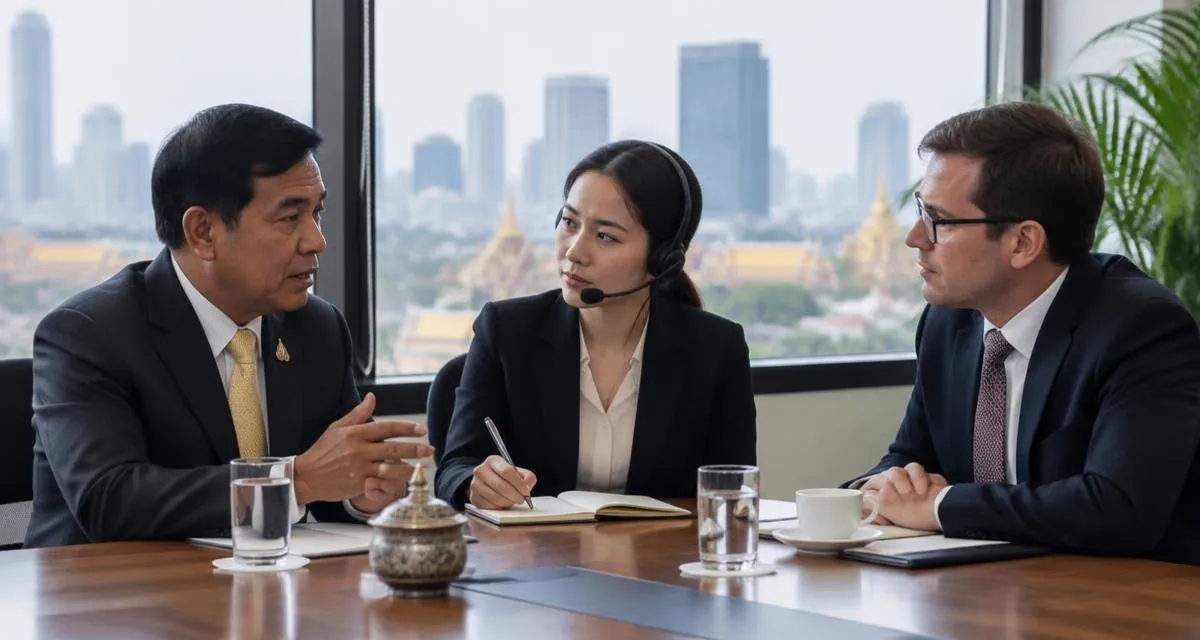
When do I need an interpreter in Thailand?
You usually need one at the District Office for marriage registration, at court, at the Land Office, at police stations and in business meetings where one party does not speak Thai. Some offices require the interpreter to sign a statement. Ask the office in advance which interpreter it accepts.
Sworn court interpreters, government-office interpretation, and business/conference interpreting — 25+ languages.
Quick Answer
We supply MFA/court-recognized interpreters for legal proceedings (courts, Land Office, Amphur, notarization, immigration) and business settings (meetings, negotiations, conferences with simultaneous booths). Half-day from a fee quoted after review.
Settings we cover
- ✓ Court hearings (sworn interpreter)
- ✓ Land Office property closing
- ✓ Amphur marriage / divorce registration
- ✓ Notary public appointments
- ✓ Immigration Bureau interviews
- ✓ Arbitration (THAC/SIAC/ICC)
- ✓ Business meetings & negotiations
- ✓ M&A due-diligence sessions
- ✓ Medical consultations
- ✓ Conference simultaneous (booth)
- ✓ Depositions & witness statements
- ✓ Site visits & factory audits
FAQ
- What languages do you provide interpreters for?
- English, Chinese (Mandarin/Cantonese), Japanese, Korean, German, French, Spanish, Italian, Russian, Arabic, Hindi, Bahasa, Vietnamese, Burmese, Lao, Khmer — 25+ languages total.
- For what settings?
- Court hearings (sworn court interpreter), Land Office closing, Amphur marriage/divorce, notarization, immigration interview, arbitration, business meetings, medical appointments, and conferences (simultaneous / consecutive).
- How far in advance should I book?
- Court & Land Office: 5–7 days advance (schedule-dependent). Notary & Amphur: 2–3 days. Business meetings: 1–2 days. Urgent same-day available with surcharge subject to interpreter availability.
- Cost?
- Fees depend on the documents, destination and urgency. Send your documents for a written quote after review — no prices are published. Any government or embassy fees are set by the authority; verify them directly before filing.
Contact: 083-2494999 · LINE @NYC168 · contact@nyclegal.co.th
Choosing the mode before choosing the interpreter
Mode determines cost, staffing and room setup far more than language pair does. Consecutive interpreting, where the speaker pauses and the interpreter renders each segment, roughly doubles the elapsed time but needs no equipment and suits depositions, notarial signings and small negotiations. Simultaneous interpreting runs in real time from a booth or with a portable system and requires two interpreters per language pair rotating every twenty to thirty minutes, because sustained simultaneous work degrades measurably after that.
Whispered interpreting, or chuchotage, serves one or two listeners in a room otherwise proceeding in Thai. Liaison interpreting suits site visits and factory walkthroughs where the participants move. Booking the wrong mode is the most expensive error in this service: a conference booked as consecutive silently doubles its own schedule.
Settings we work in and what each demands
| Setting | Usual mode | Specific demand |
|---|---|---|
| Notarial signing and power of attorney | Consecutive | The interpreter's identity is recorded in the certification; neutrality is the point |
| Court and arbitration hearing | Consecutive, sometimes whispered | Register must be preserved; interpreters do not summarise or soften |
| Amphur marriage registration | Consecutive | Registrars require the interpreter to confirm the parties understood the declarations |
| Board meetings and due diligence | Simultaneous or whispered | Terminology sheet agreed in advance; confidentiality undertaking signed |
| Medical consultation | Consecutive | Clinical terms rendered literally, with clarification requested rather than guessed |
| Factory audit and site inspection | Liaison | Mobile, safety-briefed, with technical vocabulary prepared from the audit scope |
Preparation that decides quality
- Brief and materials: Agendas, prior minutes, contracts and slide decks sent ahead let the interpreter build a glossary. Interpreters given nothing in advance render accurately but slowly, and slowness is what participants perceive as poor quality.
- Terminology sheet: Party names, product names, statutory references and internal acronyms are fixed in writing before the session, so the same Thai term is not rendered three ways in one meeting.
- Room and audio check: For simultaneous work, receivers, booth or portable transmitter and a clean speaker feed are tested before participants arrive; interpreting from a room microphone at the back is the leading cause of complaint.
- Roles and turn-taking: The chair is briefed to pause for consecutive segments and to speak to the participants rather than to the interpreter.
- Confidentiality: A non-disclosure undertaking is signed before materials are released, which is standard for due diligence and litigation work.
Where interpreting ends and translation begins
An interpreter renders speech; a translator renders documents. Where a signing meeting produces a text that must be filed, the written version is a separate certified translation, and the certification attaches to the translator who prepared it. Asking the interpreter present to sign an on-the-spot rendering of a contract confuses the two roles and produces a document most registrars will not accept.
Common mistakes and how we avoid them
More questions we are asked
- How far in advance should I book?
- For conference simultaneous work, two to three weeks secures a pair with the right subject background. Consecutive appointments can often be arranged within days.
- Do you provide equipment?
- Yes, portable systems for small groups and booth setups for conferences, arranged with the venue's technical staff.
- Can the interpreter also certify the translation?
- Only if separately qualified for that document type; the roles and the certifications are distinct.
- Which languages do you cover?
- Thai paired with major European and Asian languages; rarer pairs are arranged with lead time and confirmed before booking.
- How is time charged?
- By half-day and full-day blocks with defined overtime, because interpreter availability is committed in blocks rather than by the minute.
- Can interpreting be provided remotely?
- Yes, over the client's platform, provided a clean audio feed and a rehearsal are arranged in advance.
Knowledge bases behind every service
3,057 answered questions written by our lawyers and translators, grouped by service. Free to read, no sign-up.
- Master Service Hub — every service we file
The cross-service index: certified translation, interpreting, visa/work permit/BOI, tax-legal-estate, cross-border M&A, aviation & maritime, and holding-company structuring.
649 answered questions
- Certified translation — every language
Certified translation across civil, academic, corporate, contractual, financial, medical, technical and IP documents — with the Notary → MFA → embassy legalization chain handled end to end.
500 answered questions
- Thai MFA consular legalization
Thai MFA legalization workflow: fees, turnaround, inbound foreign documents, and how the chain connects to destination-country apostille requirements.
500 answered questions
Official sources
The information on this page follows the official sources below. Always check the latest version before you file.
- Department of Consular Affairs — document legalisation— Ministry of Foreign Affairs
- Immigration Bureau — visas, 90-day reporting, TM.30— Immigration Bureau
- Department of Provincial Administration — civil & family registration— Department of Provincial Administration
- Lawyers Council of Thailand — Notarial Services Attorneys— Lawyers Council of Thailand
- Office of the Council of State — Thai law database— Office of the Council of State
Related services
Most document work runs across several steps — jump straight to the next one you need.
- Certified translation
- Consular legalization
- Notary Public
- Thailand visa
- Full service index
- Knowledge index
Contact us by phone, LINE or email for a free initial enquiry and a quote after document review. Timing depends on the work and relevant authorities.
General information before proceeding: Confirm current requirements with the receiving authority before using your documents. This page is not a legal opinion for your individual case — meet the team · editorial policy
Not sure which service you need? Read the guides
Each guide answers first, then explains: decision criteria, comparison tables, the real process and the mistakes we see most often.
- Choosing a certified translation provider
How to pick a translator accepted by consular, embassy and receiving bodies
- Services for expats living in Thailand
Signature certification, residence, marriage and everyday paperwork
- Notary Public and consular legalization
The correct order of steps before sending documents abroad
- Choosing the right visa and work permit
Compare visa categories and the documents each one needs translated
- Translation by language
English, Chinese, Japanese, European, Arabic, Russian and embassy rules
- Specialized translation
Contracts, financial statements, MSDS, ISO and BOI filings
Talk to us first: 083-2494999 · LINE @NYC168 · contact@nyclegal.co.th
Frequently asked questions
- When is an interpreter legally required in Thailand?
- An interpreter is required whenever a person who does not understand Thai takes part in an official act — district-office marriage registration, police investigations, court hearings, land office transactions and certain immigration interviews. In criminal proceedings the Criminal Procedure Code guarantees interpretation, and courts keep their own interpreter lists.
- What is the difference between consecutive and simultaneous interpreting?
- Consecutive interpreting alternates between speaker and interpreter and suits meetings, interviews and district-office appointments, while simultaneous interpreting is delivered in real time from a booth or headset and suits conferences and long hearings. Simultaneous work requires two interpreters rotating every 20–30 minutes because sustained concentration beyond that degrades accuracy.
- How far ahead should an interpreter be booked?
- Book English, Chinese and Japanese interpreters at least two to three working days ahead, and rare languages such as Hebrew, Hungarian, Nepali or Amharic one to two weeks ahead, since only a handful of qualified interpreters operate in Thailand for those pairs. Court and police assignments should be booked as soon as the date is known because the interpreter must be available for the entire session.
- Can interpreting be done online?
- Yes for business meetings, due-diligence calls and many consultations, and some Thai courts allow remote hearings with an interpreter joining by video. District offices, land offices and police stations generally require the interpreter to be physically present and to sign the record, so remote interpreting is not accepted for those acts.
More on Interpreters (government, court, business) →All FAQs