


Home / Interpretation / On-Site
On-Site Interpretation for Court, Notary & Business
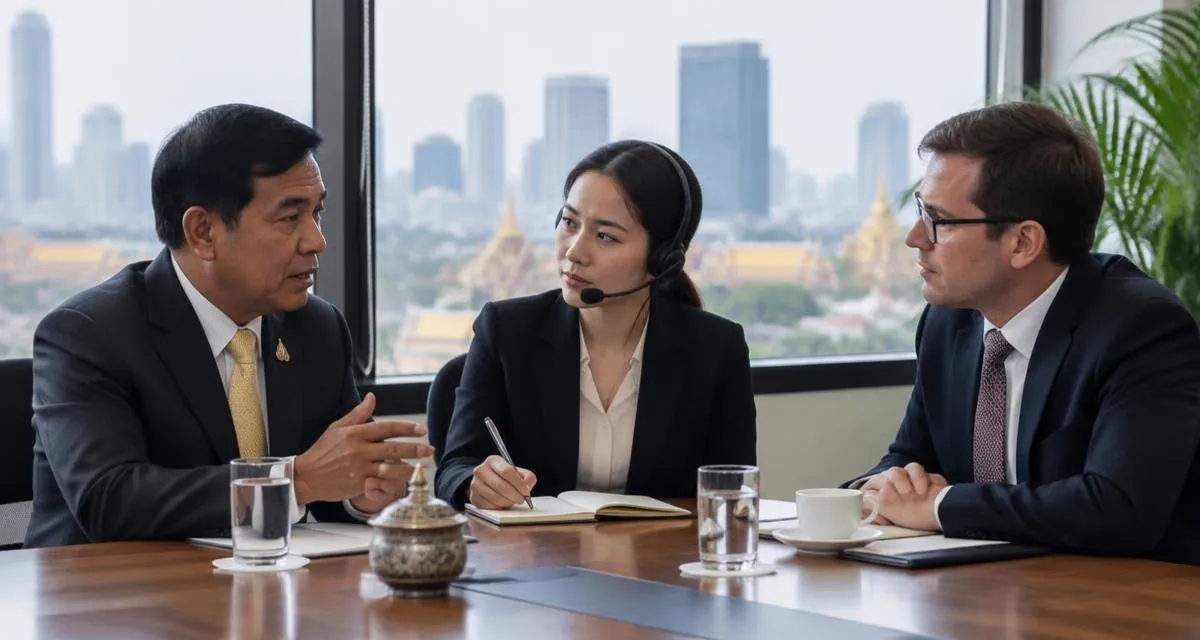
Professional interpreters dispatched anywhere in Thailand — court, police, notary, embassy, hospital, negotiations.
Quick Answer
15+ language pairs, MOJ-certified court interpreters, and simultaneous conference teams. Bookings from a fee quoted after review (half-day) to a fee quoted after review (full-day team + equipment). Same-day availability for Bangkok and Khon Kaen; 48–72h upcountry.
FAQ
- What settings do you cover?
- Court hearings, police interrogations, notary signings, embassy interviews, hospital consultations, business negotiations, arbitration hearings, and factory audits. On-site anywhere in Thailand with 48–72h notice; same-day for Bangkok/Khon Kaen.
- Which languages?
- Thai ↔ English, Chinese (Mandarin/Cantonese), Japanese, Korean, French, German, Spanish, Italian, Russian, Arabic, Hindi, Vietnamese, Burmese, Khmer, Lao. Rare languages (Farsi, Turkish, Portuguese, Dutch) available with 5–7 day notice.
- Consecutive vs simultaneous?
- Consecutive (speaker pauses, interpreter renders) — for court, notary, police, negotiations. Simultaneous (real-time with booth/headset) — for conferences, arbitration. We provide both; simultaneous requires 2-interpreter team + AV equipment.
- Rates?
- Fees depend on the documents, destination and urgency. Send your documents for a written quote after review — no prices are published. Any government or embassy fees are set by the authority; verify them directly before filing.
Related services
Contact: 083-2494999 · LINE @NYC168 · contact@nyclegal.co.th
Knowledge bases behind every service
3,057 answered questions written by our lawyers and translators, grouped by service. Free to read, no sign-up.
- Master Service Hub — every service we file
The cross-service index: certified translation, interpreting, visa/work permit/BOI, tax-legal-estate, cross-border M&A, aviation & maritime, and holding-company structuring.
649 answered questions
- Certified translation — every language
Certified translation across civil, academic, corporate, contractual, financial, medical, technical and IP documents — with the Notary → MFA → embassy legalization chain handled end to end.
500 answered questions
- Thai MFA consular legalization
Thai MFA legalization workflow: fees, turnaround, inbound foreign documents, and how the chain connects to destination-country apostille requirements.
500 answered questions
Official sources
The information on this page follows the official sources below. Always check the latest version before you file.
- Department of Consular Affairs — document legalisation— Ministry of Foreign Affairs
- Immigration Bureau — visas, 90-day reporting, TM.30— Immigration Bureau
- Department of Provincial Administration — civil & family registration— Department of Provincial Administration
- Lawyers Council of Thailand — Notarial Services Attorneys— Lawyers Council of Thailand
- Office of the Council of State — Thai law database— Office of the Council of State
Related services
Most document work runs across several steps — jump straight to the next one you need.
- Certified translation
- Consular legalization
- Notary Public
- Thailand visa
- Full service index
- Knowledge index
Contact us by phone, LINE or email for a free initial enquiry and a quote after document review. Timing depends on the work and relevant authorities.
General information before proceeding: Confirm current requirements with the receiving authority before using your documents. This page is not a legal opinion for your individual case — meet the team · editorial policy
Not sure which service you need? Read the guides
Each guide answers first, then explains: decision criteria, comparison tables, the real process and the mistakes we see most often.
- Choosing a certified translation provider
How to pick a translator accepted by consular, embassy and receiving bodies
- Services for expats living in Thailand
Signature certification, residence, marriage and everyday paperwork
- Notary Public and consular legalization
The correct order of steps before sending documents abroad
- Choosing the right visa and work permit
Compare visa categories and the documents each one needs translated
- Translation by language
English, Chinese, Japanese, European, Arabic, Russian and embassy rules
- Specialized translation
Contracts, financial statements, MSDS, ISO and BOI filings
Talk to us first: 083-2494999 · LINE @NYC168 · contact@nyclegal.co.th
Modes of interpreting and where each belongs
Choosing the wrong mode is the most expensive mistake in interpreting, because it is discovered mid-session. Consecutive interpreting — the speaker pauses, the interpreter renders — is the correct choice for depositions, notarial signings, medical consultations and negotiations, where accuracy and the record matter more than speed. Simultaneous interpreting from a booth suits conferences and board meetings with a fixed agenda, and requires two interpreters per language pair rotating roughly every twenty to thirty minutes.
Whispered interpreting, chuchotage, works for one or two listeners in a room otherwise operating in Thai. It is not a cheap substitute for a booth: beyond two listeners the acoustics fail and the room resents it. Liaison interpreting, the mode used on factory walkthroughs and site inspections, is consecutive work performed while moving, and it requires the interpreter to have the technical vocabulary before arriving, not to acquire it in the corridor.
| Setting | Recommended mode | Staffing |
|---|---|---|
| Notarial signing / power of attorney | Consecutive | One interpreter; identity of the interpreter recorded |
| Court hearing or deposition | Consecutive | One interpreter, sworn on the record; second for long hearings |
| Conference, half or full day | Simultaneous with booth | Two per language pair, rotating |
| Board meeting, small room | Whispered or table-top simultaneous | Two for sessions beyond ninety minutes |
| Factory audit / site visit | Liaison | One, briefed on process vocabulary in advance |
| Hospital or clinic | Consecutive | One; medical terminology pack supplied beforehand |
Preparation is the deliverable
- A glossary agreed before the session: entity names, product names, job titles and any term the client uses in a non-standard way.
- Documents in advance under confidentiality — contracts, slide decks, medical summaries — because an interpreter reading a contract for the first time aloud is a risk, not a service.
- Names and roles of participants, so honorifics and titles are rendered correctly in Thai, where they carry more weight than in English.
- Agreed handling of ambiguity: the interpreter asks for clarification rather than guessing, and the parties are told at the outset that this will happen.
- For legal settings, confirmation of whether a verbatim record is being taken, which changes register and pace.
Legal and notarial settings
Where a document is signed before a Notarial Services Attorney and one signatory does not read the language of the document, the interpreter's presence is part of the validity of what happens in the room. The attorney records that the content was interpreted and identifies the interpreter. An interpreter who is also a party, a relative of a party, or an employee of one side undermines that record, so we do not accept those assignments.
In court, interpreting is governed by the procedural rules and the interpreter's role is strictly limited to rendering what is said. The interpreter does not summarise, does not explain Thai procedure to the witness, and does not answer on the witness's behalf. Clients occasionally expect the interpreter to act as an advocate; setting that expectation correctly before the hearing avoids friction on the day.
Booking, timing and logistics
- Scope the session: Mode, language pair and direction, subject matter, number of listeners, and whether a recording or transcript will be produced.
- Confirm duration honestly: Sessions overrun; we plan the interpreter's schedule with a buffer rather than forcing a hard stop mid-testimony.
- Send materials under NDA: Preparation materials are handled under confidentiality and destroyed or returned after the assignment, consistent with PDPA obligations where personal data is involved.
- Equipment check for simultaneous: Booth, receivers and a technician are confirmed the day before; a failed receiver count stops a conference more often than a failed interpreter.
- Debrief and follow-up: Terminology decisions made during the session are recorded so subsequent sessions and any written translation stay consistent.
Common mistakes and how we avoid them
More questions we are asked
- Do you provide interpreters outside Bangkok?
- Yes, including provincial courts, factories and hospitals. Travel and accommodation are planned as part of the booking rather than added afterwards.
- Can the same person interpret and translate the resulting document?
- Often yes, and continuity of terminology is a benefit. In court settings the roles may need to be separated depending on the tribunal's practice.
- How is confidentiality handled?
- By written non-disclosure covering the interpreter personally, with materials returned or destroyed after the assignment and personal data handled under PDPA principles.
- What notice do you need?
- Straightforward consecutive assignments can be arranged at short notice. Simultaneous work with equipment, and rare language pairs, need substantially more lead time.
Frequently asked questions
- When is an interpreter legally required in Thailand?
- An interpreter is required whenever a person who does not understand Thai takes part in an official act — district-office marriage registration, police investigations, court hearings, land office transactions and certain immigration interviews. In criminal proceedings the Criminal Procedure Code guarantees interpretation, and courts keep their own interpreter lists.
- What is the difference between consecutive and simultaneous interpreting?
- Consecutive interpreting alternates between speaker and interpreter and suits meetings, interviews and district-office appointments, while simultaneous interpreting is delivered in real time from a booth or headset and suits conferences and long hearings. Simultaneous work requires two interpreters rotating every 20–30 minutes because sustained concentration beyond that degrades accuracy.
- How far ahead should an interpreter be booked?
- Book English, Chinese and Japanese interpreters at least two to three working days ahead, and rare languages such as Hebrew, Hungarian, Nepali or Amharic one to two weeks ahead, since only a handful of qualified interpreters operate in Thailand for those pairs. Court and police assignments should be booked as soon as the date is known because the interpreter must be available for the entire session.
- Can interpreting be done online?
- Yes for business meetings, due-diligence calls and many consultations, and some Thai courts allow remote hearings with an interpreter joining by video. District offices, land offices and police stations generally require the interpreter to be physically present and to sign the record, so remote interpreting is not accepted for those acts.
More on Interpreters (government, court, business) →All FAQs