


FTA Utilisation & Rules of Origin (RCEP / ASEAN / TAFTA)
ใช้สิทธิพิเศษภายใต้ FTA และกฎว่าด้วยถิ่นกำเนิดสินค้า (RCEP / ASEAN / TAFTA) · § CrossBorder
What to know before you act
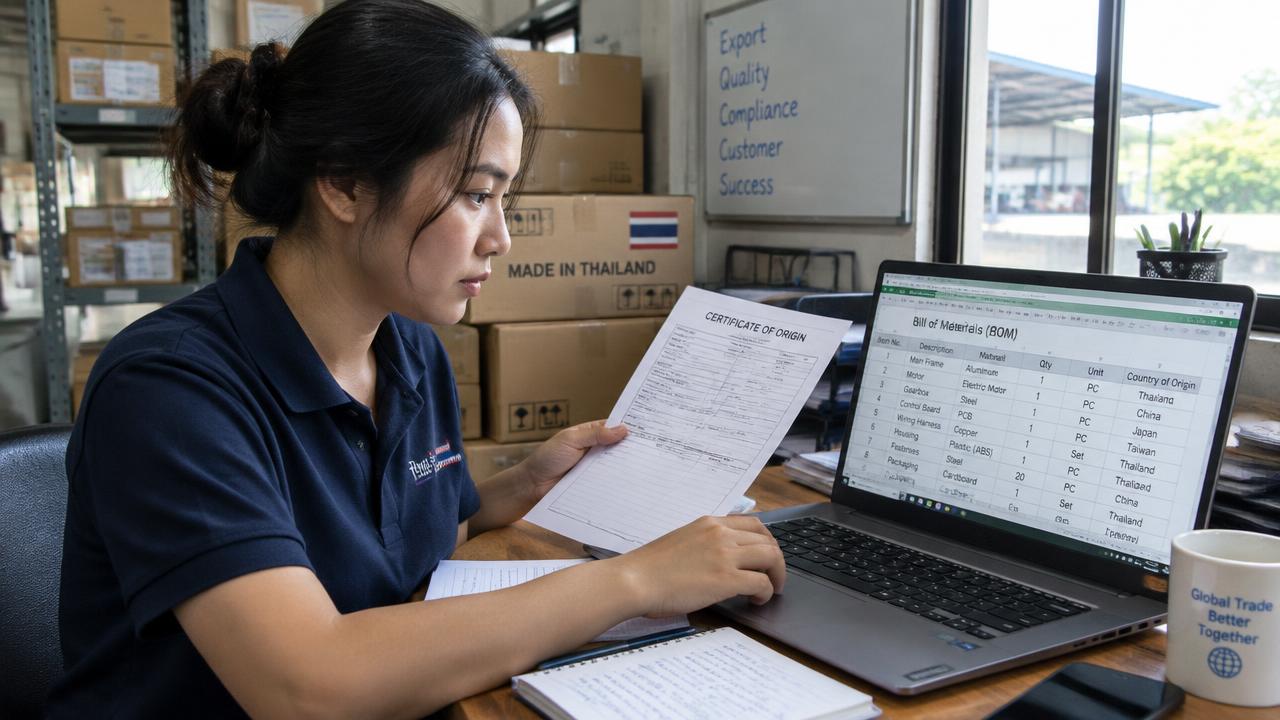
FTA duty preference (ATIGA, RCEP, ACFTA, JTEPA and others) depends on the goods genuinely meeting that agreement's rules of origin. We analyse your bill of materials against change-in-tariff (CTC) or regional value content (RVC) tests, pick the agreement that gives the best result, build cost records that survive verification, and advise on certificates from the Department of Foreign Trade or self-certification where the agreement allows.
Timing and external dependencies: Per-product analysis depends on how complete your cost and supplier data are; certificate issuance follows the Department of Foreign Trade's system.
Official fee: Certificate-of-origin fees — confirm current rates with the Department of Foreign Trade.
Timing is not a promise of an outcome or hearing date. Check the notice, limitation period and current authority rules for your matter.
What to send for the first review
Send every relevant page, a dated sequence of events, any hearing or filing deadline, and the outcome you need. This lets counsel identify urgent steps, missing evidence and a precise scope of work.
- BOM + supplier declaration
- Manufacturing cost breakdown (RVC worksheet)
- Manufacturing process flow + factory audit
Legal Basis
RCEP (in force 1 Jan 2022) · ATIGA · ACFTA · AKFTA · AJCEP · AANZFTA · TAFTA · TIFA · JTEPA · Peru TPCEP · Wholly Obtained (WO) + Product Specific Rules (PSR) + Regional Value Content (RVC) + Change in Tariff Classification (CTC) · Direct Consignment Rule · DFT Form D/E/AK/FTA/RCEP notifications.
📚 Official sources — check the current law and procedure before acting
- สำนักงานคณะกรรมการกฤษฎีกา — ตัวบทกฎหมายฉบับทางการ— Office of the Council of State
Who Needs This
Thai exporters, MNCs with regional supply chains, contract manufacturers, EEC-based factories, automotive tier 1/2, electronics assemblers.
Required Documents
- BOM + supplier declaration
- Manufacturing cost breakdown (RVC worksheet)
- Manufacturing process flow + factory audit
- Supplier origin declaration + upstream Form D/E
- Direct consignment evidence (B/L + transhipment cert)
- Prior DFT approval letter (for Approved Exporter).
Common Pitfalls
- Computing RVC on selling price instead of the agreement's formula
- No supplier origin declarations when verification arrives
- Changing material sources but reusing old origin analysis
- Assuming 'made in Thailand' qualifies under every agreement
Typical Use-cases
- EEC automotive tier 1 · TH→JP harness · JTEPA CTC + RVC 40% · 8% duty saved · the statutory threshold/yr.
- Electronics assembler · RCEP cumulation TH+CN+VN · Form RCEP · 5% Japan tariff saved.
- Textile exporter · TH→EU GSP+ · yarn-forward rule · Cambodian yarn disqualified · reformulated.
- Food processor · TH→AU AANZFTA · SPS + RoO combined · full duty elimination.
FAQ
- RCEP or ATIGA?
- It depends on destination, each agreement's duty rate and which origin rule the product meets — compare per product.
- Can the importing country verify origin later?
- Yes, through Thai authorities, so keep cost records for the required period.
- What if origin was wrong?
- The importer may face recovered duty and penalties, and the trade relationship can suffer.
Other Legal Services
Request a quote — Call 083-2494999 · LINE @NYC168 · contact@nyclegal.co.th
Knowledge bases behind every service
3,057 answered questions written by our lawyers and translators, grouped by service. Free to read, no sign-up.
- Master Service Hub — every service we file
The cross-service index: certified translation, interpreting, visa/work permit/BOI, tax-legal-estate, cross-border M&A, aviation & maritime, and holding-company structuring.
649 answered questions
- Certified translation — every language
Certified translation across civil, academic, corporate, contractual, financial, medical, technical and IP documents — with the Notary → MFA → embassy legalization chain handled end to end.
500 answered questions
- Thai MFA consular legalization
Thai MFA legalization workflow: fees, turnaround, inbound foreign documents, and how the chain connects to destination-country apostille requirements.
500 answered questions
Official sources — legal services
The information on this page follows the official sources below. Always check the latest version before you file.
- Office of the Judiciary— Office of the Judiciary
- Ministry of Justice— Ministry of Justice
- Lawyers Council of Thailand — Notarial Services Attorneys— Lawyers Council of Thailand
- Office of the Council of State — Thai law database— Office of the Council of State
- Royal Thai Government Gazette— Royal Thai Government Gazette
Related services
Most document work runs across several steps — jump straight to the next one you need.
Contact us by phone, LINE or email for a free initial enquiry and a quote after document review. Timing depends on the work and relevant authorities.
General information before proceeding: Confirm current requirements with the receiving authority before using your documents. This page is not a legal opinion for your individual case — meet the team · editorial policy
Not sure which service you need? Read the guides
Each guide answers first, then explains: decision criteria, comparison tables, the real process and the mistakes we see most often.
- Choosing a certified translation provider
How to pick a translator accepted by consular, embassy and receiving bodies
- Services for expats living in Thailand
Signature certification, residence, marriage and everyday paperwork
- Notary Public and consular legalization
The correct order of steps before sending documents abroad
- Choosing the right visa and work permit
Compare visa categories and the documents each one needs translated
- Translation by language
English, Chinese, Japanese, European, Arabic, Russian and embassy rules
- Specialized translation
Contracts, financial statements, MSDS, ISO and BOI filings
Talk to us first: 083-2494999 · LINE @NYC168 · contact@nyclegal.co.th
Frequently asked questions
- Can a foreigner own 100% of a Thai company?
- Generally no for activities listed in the Foreign Business Act, where majority foreign ownership requires a Foreign Business Licence, a BOI promotion, or treaty rights such as the US–Thailand Treaty of Amity. Manufacturing and certain export activities are largely open, and BOI-promoted activities can permit full foreign ownership together with land-holding and visa privileges, so the right structure depends on the specific activity.
- What is the minimum registered capital for a Thai company?
- There is no general statutory minimum for a Thai-majority company, but practical thresholds apply: a fee quoted after review million of paid-up registered capital per foreign work permit, or a fee quoted after review million if the foreigner is married to a Thai national, and a fee quoted after review million per foreign shareholder for a Foreign Business Licence. Capital should therefore be planned around the visa and work-permit outcome you need, not the incorporation minimum.
- How long does company registration take?
- Registration at the Department of Business Development can be completed within one to three working days once the name reservation, shareholder documents and company objectives are ready, and the VAT registration and social security registration follow afterwards. The realistic end-to-end timeline including bank account opening is two to six weeks, with the bank account usually being the slowest step for foreign directors.
- What ongoing accounting obligations does a Thai company have?
- Every Thai company must keep statutory accounts, file monthly withholding tax (PND 1, 3, 53) and VAT (PP 30) returns by the middle of the following month, file the half-year corporate income tax return (PND 51) and the annual return (PND 50), and have its financial statements audited by a Thai CPA and filed with the DBD each year. Dormant companies are not exempt — nil returns and an audited statement are still required.